Designing a Unified Platform for Academic Programs, Students & Faculty
N. Manage is a powerful SaaS product for data insights and process management. It streamlines marketing and enrollment efforts, providing real-time insights into learner retention, forecasting trends, and engagement metrics for higher education institutions.
Over 24 months, I led UX and visual design — working with researchers, PMs, and developers to create a system that streamlined administration, improved faculty oversight, and simplified student enrollment.
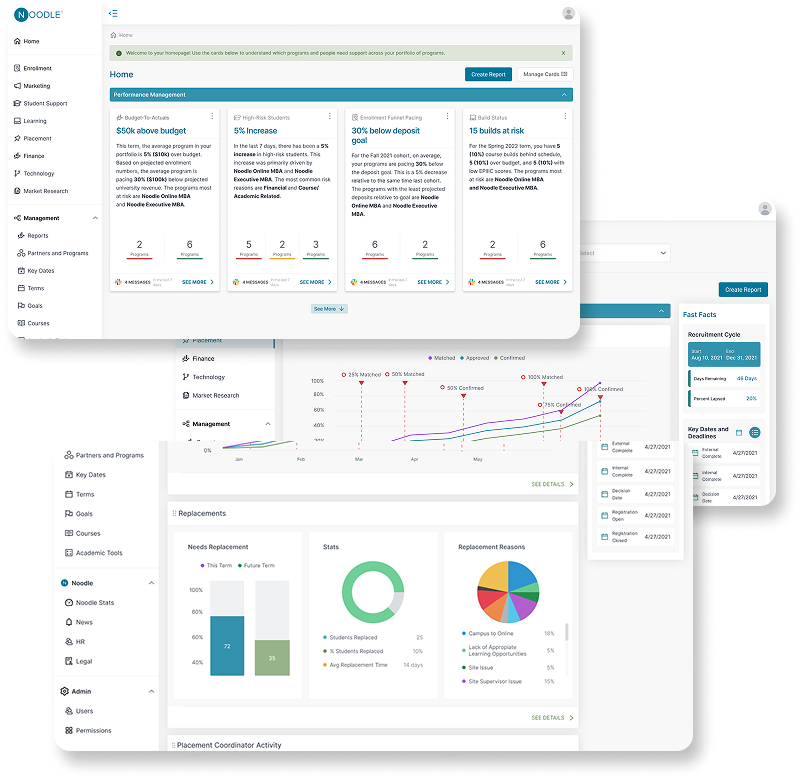
Fragmented Systems Were Blocking Decision-Making
Institutions operated across disconnected tools with no unified view. A single platform had to serve three very different user types — seamlessly.
The Fragmented Reality
- Fragmented systems caused delays in decision-making across departments
- Inconsistencies in data between faculty and administrator views
- No centralized way to track enrollment, placement, or performance
- Limited access to students and institutions for direct research feedback
- Academic complexities made intuitive UI design especially challenging
The Unified Vision
- Centralized, data-driven interface for administrators and program managers
- Real-time enrollment insights with AI-driven retention analytics
- Intuitive course management tools built for faculty oversight
- Streamlined student onboarding and enrollment workflows
- Modular design system built to scale with institutional growth
Mapping a Complex Ecosystem Before Designing Any of It
I created a complete navigation map of the platform as the first step — fully understanding the entire system before designing any screen. The primary users included students, faculty, and administrators who relied on N. Manage for learning, course management, and operational tasks.
Opportunities Identified- Optimize administration and automate processes for real-time insights
- Improve enrollment by simplifying and defining an intuitive onboarding
- Enhance faculty oversight with academic program management tools
- Leverage AI-powered data for a seamless, centralized platform
"When I am a student, faculty member, or administrator using the platform, I want a seamless experience that supports my tasks efficiently, so I can focus on learning, teaching, or managing without frustration."
A Four-Phase Repeatable Design System
We built a structured process that scaled across the entire platform. Each feature ticket followed the same four-phase flow — ensuring consistency, documentation, and alignment at every step of delivery.
Requirements
Receive ticket via Jira. Review general, product, and asset details, previous designs, data sources, and technical limitations before scoping the work.
Documentation
Open or continue a Confluence page with date, ticket URL, hypothesis about new design, and notes about opportunities for future design improvements.
Design in Figma
Work across monthly, feature, and experiments files. Design desktop and mobile mockups in all states: loading, default, empty, error, and success.
Delivery
Add links to Jira ticket, upload screenshots to Confluence, and update the Design System and Product Figma files to reflect new components.
From Wireframes to High-Fidelity, Reducing Complexity at Every Step
Each feature progressed from low-fidelity wireframes to high-fidelity designs — validated with users and stakeholders before moving forward. The course creation flow exemplifies how we reduced a complex multi-step process into a clear, guided experience.
Three Very Different People, One Platform
Administrators, faculty, and students each brought distinct needs to the platform — from operational reporting to course management to enrollment navigation. A modular design approach kept all three experiences coherent.
Program Administrator
Manages program data, enrollment records, and reporting. Needs clear dashboards and the ability to generate reports without relying on technical staff.
Faculty Member
Manages courses, student placement, and academic milestones. Needs an efficient way to track student progress and collaborate with program directors.
Student
Navigates enrollment, learning resources, and counseling services. Needs a clear, low-friction path to connect with university programs and support services.
Outcomes Across the Institution
Administrative Efficiency
Automated processes and centralized data reduced the manual workload for program administrators, enabling faster decision-making across enrollment and reporting.
Faster Student Enrollment
A streamlined, guided enrollment workflow significantly reduced the time from application to course assignment — directly improving the student experience.
Higher Faculty Satisfaction
Faculty reported improved oversight capabilities and less time spent on administrative tasks, allowing more focus on academic program quality and student outcomes.
Key Takeaways
A platform serving three very different user types over 24 months sharpened every instinct I have about scale, modularity, and research-driven design.
Research-Driven Design Boosts Adoption
Addressing real pain points — even when access to users was limited — ensured usability was never assumed. Every design decision was grounded in observed behavior.
Design & PM Collaboration is Essential
Working in lockstep with product managers on ticket scoping, documentation, and delivery ensured execution quality and alignment with evolving institutional needs.
Modular Design Systems Scale
A modular approach to components and patterns ensured the platform could adapt to new institutional requirements without needing to redesign foundational structures.