When "Just Refresh the UI" Isn't Enough
SPICE is a flexible, easy-to-use financial platform that delivers data on more than 400,000 indices across expanded asset classes. With powerful tools, advanced filtering capabilities, and access to extensive historical and constituent-level data, it supports professionals in researching, comparing, and analyzing indices to inform investment decisions.
The initial ask was straightforward: apply the SIB design library to SPICE and modernize its visual language. What unfolded was a much more nuanced challenge — one that required rethinking how modernization itself should work in a high-complexity, high-stakes financial environment.
The initial mandate was a targeted UI uplift. What we discovered was a much deeper systemic design challenge that required reframing the entire approach.
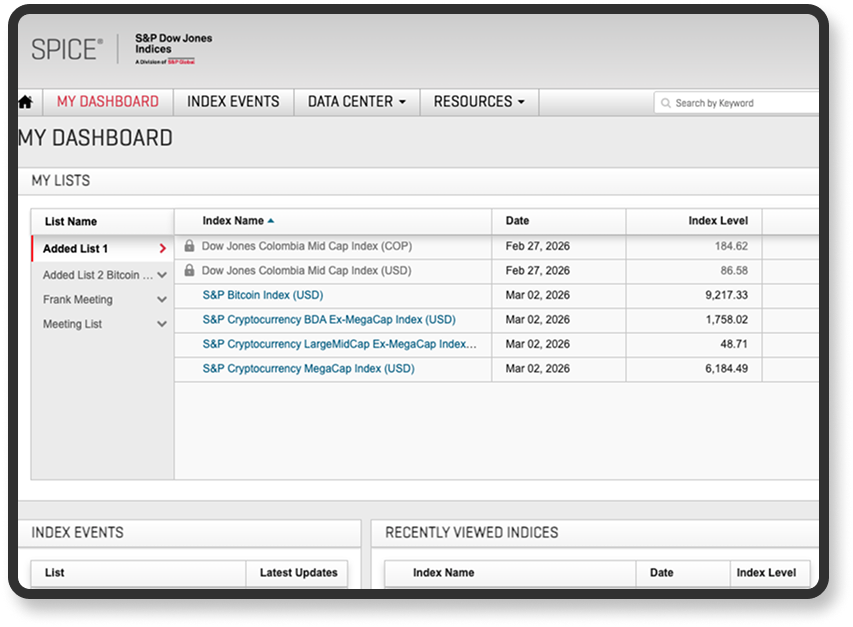
The brief that changed
On paper, this was a reskin. In reality, the scale and complexity of SPICE introduced challenges that a visual pass alone couldn't resolve. As we mapped the product, the gap between the stated brief and the actual problem came into focus.
The Initial Mandate
- Extending the SIB design library into SPICE
- Creating visual consistency
- Bridging overlapping features between SPICE and SPICE Index Builder
- Preserving existing workflows
What We Actually Found
SPICE had grown significantly in capability — expanded asset coverage, additional tools, richer datasets — but the experience hadn't evolved cohesively.
We observed- Inconsistent navigation patterns across products
- Overlapping features behaving differently
- Increased cognitive load due to accumulated UX debt
- Friction when moving between related tools
A visual refresh alone would not address these systemic issues. The work needed to go deeper.
Why modernization requires more than aesthetics
Modernizing a complex data platform requires more than updated visuals. Because users interact with large volumes of data daily — clarity, predictability, and consistency directly impact efficiency and trust.
The real opportunity wasn't just making SPICE look better. It was making it work better — and positioning it for sustainable evolution without breaking the mental models users had built over years.
Three pillars of modernization
To balance immediate delivery with long-term value, we structured the effort around three pillars. Each one addressed a different layer of the problem — strategic, experiential, and future-facing.
Business Alignment
Clarify priorities, constraints, and rollout strategy to ensure decisions supported broader product evolution. This alignment became foundational to all downstream work.
Experience Consistency
Leverage and extend the SIB design library to unify shared components and patterns across SPICE and related products, reducing cognitive load throughout.
Future Readiness
Used interactive prototypes to explore improvements beyond the immediate scope and test design direction early with stakeholders and users.
Three key user types
SPICE serves sophisticated financial professionals with high expectations for data density, workflow efficiency, and reliability. Understanding their mental models shaped every decision.
ETF Product Manager
"I want to build and monitor custom indices with real-time updates on corporate actions, so I can ensure my products stay aligned with index methodologies and market changes."
Asset Owner & Consultant
"I want to discover and customize niche benchmarks using your platform, so I can recommend passive strategies that meet specific investment goals."
Financial Advisor
"I want to research indices and download historical performance data, so I can build diversified portfolios and explain investment strategies clearly to my clients."
Resonance Testing with Domain Experts
Before finalizing key decisions, we conducted resonance testing sessions with selected subject-matter experts using clickable prototypes. The objective was directional validation — not traditional usability testing.
These experts- Interact with large-scale financial data daily
- Have strong mental models of established workflows
- Can quickly identify inefficiencies or inconsistencies
What We Gained
Strong validation on clarity
Experts confirmed that visibility and usability improvements directly addressed their workflow pain points and significantly reduced cognitive load.
Increased stakeholder confidence
Expert feedback provided evidence-backed validation that gave stakeholders confidence in the direction and justified investment in the modernization effort.
Hidden frustrations surfaced
We discovered frustrations that had become so normalized that users had stopped mentioning them. These became high-priority improvements in the roadmap.
Evidence-backed opportunities
Expert feedback validated several high-impact UX improvements that extended beyond the current scope, shaping our strategic roadmap for phase two.
This process allowed us to refine decisions before implementation and uncover deeper opportunities that internal research had missed.
Strategic Scope Management
Throughout the redesign, we identified several high-impact UX improvements that, while clearly valuable, required deeper architectural or cross-team changes. Rather than expanding scope mid-project, we applied a deliberate strategy.
The "parking lot" became a strategic asset — not a compromise. It protected delivery while enabling future evolution.
Rather than overextend the current phase, we:
This approach let the team ship with confidence while ensuring high-value ideas weren't lost to the pressure of delivery.
What This Work Delivered
A reusable modernization framework
This project crystallized a repeatable pattern for modernizing complex legacy platforms. The six steps below balance pragmatism with long-term product thinking — applicable well beyond SPICE.
-
01
Start with the brief
Understand the stated goals, but dig deeper to identify what's really driving the request. Look for systemic issues hiding beneath surface-level asks.
-
02
Evaluate ecosystem impact
A component redesign in one product often affects others. Map dependencies, overlaps, and integration points before committing to a direction.
-
03
Reframe when systemic risks emerge
If your analysis reveals deeper issues, reframe the problem. Propose a broader scope if it addresses root causes while protecting the delivery timeline.
-
04
Deliver high-impact improvements within scope
Focus on improvements that have the greatest effect on user efficiency, trust, and consistency. These become the foundation for everything that follows.
-
05
Validate direction early
Use interactive prototypes and expert feedback to validate your direction before finalizing design systems or scaling implementation across the product.
-
06
Explicitly design for the next phase
Document improvements that go beyond current scope. Structure them into a strategic roadmap that becomes the foundation for sustainable, continuous evolution.
More than a UI uplift
SPICE 3.0 was not simply a UI uplift. It was a strategic bridge between accumulated complexity and a more unified, scalable product experience. The most meaningful outcome wasn't just the interface we shipped — it was positioning the platform to evolve with confidence.
Platform Intelligence
Understanding how the platform had evolved, where complexity had accumulated, and why users developed workarounds shaped every decision we made.
User-Centered Validation
Domain experts brought credibility and discovered insights that internal research had missed. Their confidence directly enabled stakeholder buy-in.
Experience Simplification
Consistency, clarity, and predictability aren't cosmetic — they're essential infrastructure for complex data platforms where users manage high cognitive load.